
FILTERS, SCREENS & SIEVES
Metching photo-etches metal filters, screens and sieves from 0.05–2.5 mm material. The opening pattern is made to your drawing. Hole diameter alone does not describe a filter: pitch, open area, sheet thickness and the supporting border affect how it fits and works in the assembly.
Etching forms the opening pattern without punching each hole. It can be useful for thin sheets, closely spaced features and designs that need revision. The choice between etching, stamping and other processes still depends on the material, geometry, quantity and acceptance requirements.
The Limitations of Traditional Stamping
For large-scale, simple production runs, mechanical stamping (perforation) is a common choice. However, as designs become more intricate, the "old way" starts to show its flaws:
-
Expensive Tooling: Hard steel dies are costly to produce and maintain.
-
Design Rigidity: Once a tool is made, changing the design is expensive and slow.
-
Material Stress: Physical punching can warp the metal or leave behind burrs—tiny, jagged edges that can contaminate a filtration process.
-
Limited Complexity: Stamping struggle with very thin materials or ultra-fine mesh patterns.
Photochemical Etching: The Smarter Alternative
Photochemical etching is a subtractive manufacturing process that uses a chemical reaction to selectively remove material. Instead of "hitting" the metal, we "shape" it with liquid precision.
Why choose etched filters over stamped ones?
-
Limitless Complexity: Because we use digital tooling, we can create complex geometries and hole structures that are physically impossible to stamp.
-
Edges and Flatness: Chemical removal avoids conventional punching burrs. Flatness and surface condition still need to be specified and inspected, especially for thin material with a high open area.
-
Rapid Prototyping: Digital tooling means we can move from a CAD design to a finished part in a fraction of the time. Need to change a hole diameter by 0.05mm? We simply update the file—no new expensive dies required.
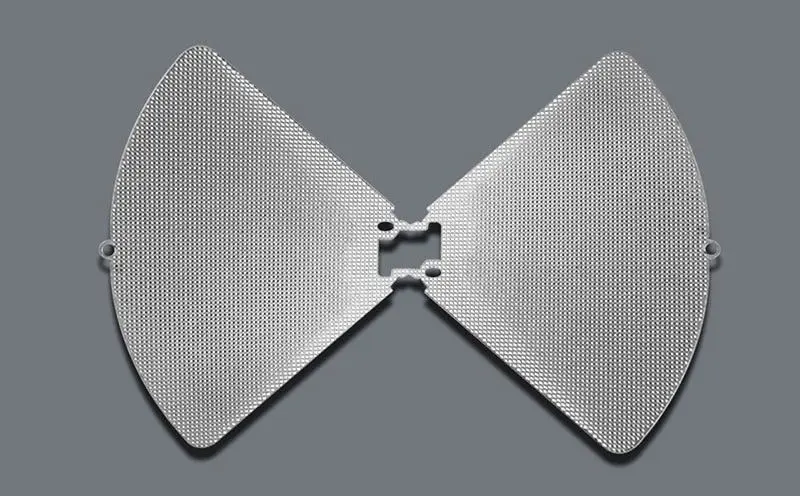
Uncompromising Precision
Review the smallest opening together with sheet thickness, web width and open area. Narrow webs and high open area can make a screen harder to handle without bending. The drawing should identify the critical openings, supporting border, mounting features and flatness requirement.
-
Minimum Opening Size: Assessed against material thickness, alloy and the surrounding pattern.
-
Tolerance/Accuracy: Evaluated based on material thickness, drawings and processing requirements. No single fixed tolerance is promised for all projects.
-
Material Thickness: Ranging from 0.05mm to 2.5mm
Openings are etched together, but their dimensions and distribution still need to be checked against the agreed inspection plan. If filtration performance is critical, define the required particle retention, pressure drop or flow test as well as the dimensional checks.
Elevate Your Manufacturing with Metching
For a quotation, send the material grade, thickness, overall dimensions, hole pattern and quantity. Include mounting details and any cleanliness, surface finish or inspection requirements. For a food-contact, medical or other regulated application, state the applicable requirements for review; suitability cannot be inferred from the hole pattern alone.