Compressor Valve Plates: Photo Etching vs Stamping for Thin Stainless Steel Reeds
Updated: 1 day ago
A compressor valve plate may look simple in CAD, but its thin reed geometry determines opening response, sealing, impact behavior and fatigue risk. This 2026 engineering guide is written for compressor design engineers and technical buyers comparing photo etching with stamping.
Quick Answer
Photo etching is especially valuable for prototype and development-stage reeds that change frequently. Stamping usually becomes strongest when geometry is stable and annual volume is very high.
What Does a Compressor Reed Valve Actually Do?
A reed valve is pressure-actuated. Differential pressure flexes the reed away from its seat to allow gas flow; pressure reversal closes it again.
The operating environment can include repeated bending, impact against a valve seat or retainer, pressure pulsation, flutter, local stress concentration, fatigue and wear.
Research into refrigeration compressor reed failures has identified impact fatigue and surface damage as important failure mechanisms:
Why Manufacturing Method Matters
Two reed valves can be identical in CAD yet differ at the edge after manufacturing. The process may influence burrs, local deformation, residual stress, heat input, edge profile, surface damage, dimensional consistency and flatness.
For a thin flexible spring component, these differences can matter more than they would on an ordinary bracket.
Stamping Compressor Reed Valves
Stamping is a proven method and makes excellent economic sense when annual volume is very high, the design is stable, hard tooling can be amortized, process parameters are validated and unit cost dominates the decision.
For a mature compressor platform making millions of one reed geometry, stamping may be the obvious choice. Photo etching does not automatically replace it.
Why Consider Photo Etching?
Compressor programs rarely begin with the ten-millionth identical part. They begin with Version A, then B, then a wider neck, a longer arm, a different slot, another thickness and several fatigue-test variants.
Photo chemical etching uses photographic/digital tooling instead of a hardened cutting die. Geometry can therefore be revised without rebuilding a conventional stamping tool.
Photochemical machining guidance identifies burr-free, stress-free processing without a heat-affected zone as key characteristics:
The value proposition is not necessarily the cheapest 10-millionth reed. It is often a lower-cost way to change your mind during development.
Photo Etching vs Stamping for a Compressor Valve Plate
For 0.1–0.5 mm thin metal, both processes can be strong candidates. Photo etching is typically stronger for prototype tooling cost, rapid geometry changes, complex slots and development quantities. Stamping is typically stronger for mature very-high-volume production, formed features and coining operations.
The key variable is not simply etching versus stamping. It is development stage + geometry + functional requirement + volume.

Where Photo Etching Becomes Especially Interesting
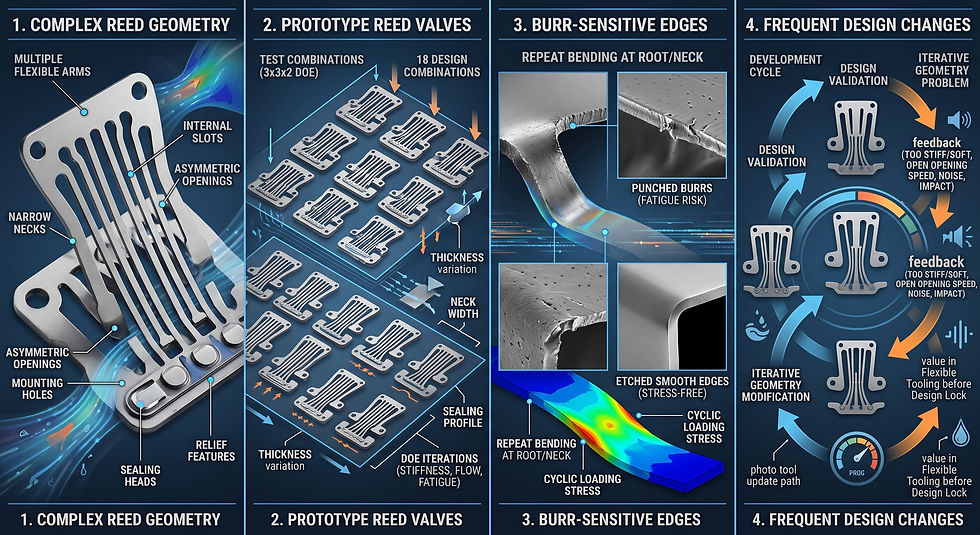
1. Complex Reed Geometry
Modern reeds can include multiple flexible arms, narrow necks, internal slots, asymmetric openings, mounting holes, relief features and sealing heads. Complex flat geometry is a natural area to evaluate photo etching because the pattern is produced across the sheet simultaneously.
2. Prototype Reed Valves
Testing three sheet thicknesses, three neck widths and two sealing-head profiles already creates 18 design combinations. Flexible photo tooling makes DOE around stiffness, opening behavior, fatigue, flow, noise, impact and sealing much easier to iterate.
3. Burr-Sensitive Edges
A spring reed may repeatedly flex near a root, neck or inside corner. A local defect can become significant under cyclic loading.
Photo etching does not eliminate fatigue; alloy, grain structure, rolling direction, heat treatment, geometry, stress and real operating conditions remain critical. But avoiding a mechanical shearing burr can still be meaningful for fatigue-sensitive components.
4. Frequent Design Changes
A reed may prove too stiff, too flexible, too noisy, too slow to open or too aggressive in impact. Development then becomes an iterative geometry problem. Flexible tooling has value precisely because the design is not yet fixed.
Etching Has Its Own Design Rules
Photo etching removes metal vertically and laterally, so minimum slots, lands, radii and tolerance all interact with material thickness.
A drawing that specifies 0.20 mm material with an extremely narrow internal slot should not be assumed manufacturable without review. Burr-free also does not mean a mathematically vertical wall; etched edges have a characteristic undercut profile.
Material Selection Is More Important Than Saying Stainless Steel
A fatigue-critical reed drawing should define the actual alloy, thickness, temper or hardness, and any relevant heat treatment or rolling direction.
Metching can process materials including SUS301, SUS304, SUS316, 17-7PH and other suitable thin metals, but final material selection remains an engineering decision based on the compressor's fatigue and operating requirements.
When Stamping Is Still the Better Answer
If geometry is finalized, annual volume is in the millions, the material and die are validated, and design revisions are unlikely, moving the part to photo etching may not make economic sense.
Stamping is also inherently better for features that require forming, embossing, coining or three-dimensional deformation.

A Better Compressor Development Strategy
Phase 1 — Concept: use photo etching to create multiple reed geometries.
Phase 2 — Engineering validation: optimize dynamics, noise, fatigue, flow and impact.
Phase 3 — Pilot production: compare real total project cost for photo etching and production stamping.
Phase 4 — Mature high volume: if volume and design stability justify hard tooling, stamping may take over.
Engineers Should Optimize the Reed Before Optimizing Unit Cost
A reed becomes expensive when it fails, leaks, creates noise, reduces efficiency, causes warranty claims or forces a redesign after hard tooling is complete.
During development, the sequence should be geometry → dynamics → fatigue → manufacturing scale, not the other way around.
DFM Checklist for an Etched Compressor Reed
Before quotation, define exact material alloy, sheet thickness, temper/hardness where relevant, genuinely critical dimensions, slot width and inside radii, flatness only where function requires it, rolling direction if mechanically important, surface-finish requirements, prototype quantity and annual production volume, plus STEP/DXF/DWG and a dimensioned drawing.
Where Metching Fits
Metching manufactures precision flat metal parts by photo chemical etching, including valve reeds, spring plates, orifice plates, filter discs and other thin flow-control components.
Metching processes material thicknesses from 0.05–2.5 mm. Prototype lead times are confirmed after reviewing the material, drawing and production requirements. Tolerances are evaluated based on material thickness, drawings and processing requirements. Metching does not apply a single fixed tolerance to every project.
If you are developing a compressor or pump valve reed, send the drawing to info@metching.com. We can review material, thickness, slot geometry, critical tolerances and etching feasibility before quotation.
FAQ
Can compressor reed valves be photo etched?
Yes. Thin flat metal reed valves can be good candidates for photo chemical etching, particularly for R&D, prototype and low-to-medium-volume production, subject to material, geometry and tolerance review.
What thickness are compressor reed valves?
There is no universal thickness. A compressor valve-reed patent published in 2026 gives example metal-sheet thicknesses of approximately 0.1 to 0.5 mm.
Is chemical etching better than stamping for reed valves?
Not universally. Etching is strong for rapid design changes and development quantities; stamping is usually strongest for mature, stable designs at very high volumes.
Does photo etching leave burrs?
Photo chemical etching removes metal chemically instead of mechanically shearing it, so it does not create conventional punch or cutting burrs.
Can etched reed valves still fail from fatigue?
Yes. Fatigue depends on alloy, temper, geometry, stress, surface condition, impacts, heat treatment and the real compressor operating environment.
Is stamping always cheaper?
No. At very high stable volumes stamping often wins on unit price, but development-stage tooling, revisions and multiple design variants can change total project cost.
Can several reed designs be etched in one prototype batch?
Often yes when material, thickness and process setup are compatible, which makes etching useful for engineering DOE and geometry validation.
Related Engineering Guides
Request a Compressor Valve Plate DFM Review
For a new compressor valve plate, send Metching the dimensioned drawing, alloy, thickness, temper or hardness, critical slot and root geometry, prototype quantity and annual demand. We can review etching feasibility, likely secondary operations and whether stamping should be considered for later high-volume production.


Comments