When a Precision Metal Filter Fails, the Problem Often Starts in the Drawing

Updated: Sep 11

A precision metal filter can look deceptively simple on a drawing: a thin sheet, a border and a field of repeated holes or slots. In practice, some of the hardest filter projects are the ones where every individual dimension looks reasonable, but the dimensions do not work together.
The usual conflict is easy to recognize. The designer wants smaller openings to catch finer particles, more open area to reduce pressure drop, thinner webs to fit more openings into the same footprint, and enough material thickness to keep the part rigid. Each requirement makes sense on its own. Put them together and the process window can disappear.
That is why a useful manufacturability review starts with the filter function, not with a generic statement that a certain hole size is achievable.
Start with the job the filter actually has to do
Before discussing etching tolerances, we want to know what the openings are controlling. Is the part stopping particles, metering liquid, protecting a sensor, distributing gas, supporting another filtration medium, or simply preventing debris from entering an assembly?
That answer changes the drawing. A particle-retention screen may be driven by the maximum opening. A flow-control plate may care more about total open area and pressure drop. A protective screen may need enough stiffness to survive handling even if a thinner sheet would make the holes easier to etch. In other words, the critical dimension is not always the number with the tightest tolerance.
Hole size and material thickness are linked
Photochemical etching removes metal vertically and laterally. As the etchant travels through the sheet, it also attacks the sidewalls. The thicker the metal, the longer that reaction must continue and the more important lateral undercut becomes.
This is why we do not treat aperture diameter and sheet thickness as independent specifications. As a practical starting point, a through-hole or slot close to the material thickness deserves careful review. Features comfortably larger than the thickness generally give the process more room. Features below that relationship may still be worth testing in some materials and geometries, but they should not be assumed from a drawing alone.
The same applies to the metal left between openings. A filter with acceptable hole dimensions can still be fragile if the remaining web is too narrow for the thickness, pattern density and required open area.
Open area is where many drawings become unrealistic
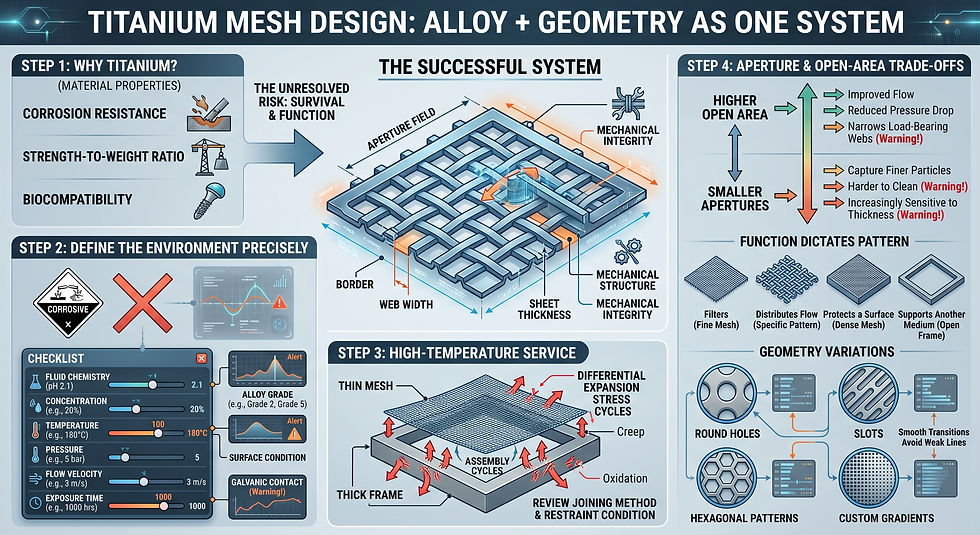
Open area is often treated as a percentage to maximize. In a real component, increasing it means removing more metal. That can reduce pressure drop, but it also reduces the structure carrying the load.
If a customer sends us a dense perforation pattern, we look at the aperture, pitch and web width together. We also look at the unperforated border. A sensible frame around the active area can make a very fine screen much easier to handle, inspect, clean and assemble. Remove too much of that supporting structure and a flat filter can become difficult to keep flat long before it reaches the customer's assembly line.
Round holes, slots and custom apertures behave differently
A round hole is usually the easiest feature to discuss because the etchant approaches the geometry uniformly. Slots introduce another variable: length. Very long, narrow slots can leave slender metal ribs that are more vulnerable during processing and handling. Sharp internal corners also do not remain mathematically sharp after chemical removal.
None of this means custom apertures are a poor fit for photo etching. Quite the opposite: one of the reasons engineers choose the process is that circles, rectangles, tapered openings, irregular perforations and mixed patterns can be created without a punch for every feature. It simply means that the aperture geometry should be designed as an etched feature rather than copied from a machining drawing.
Do you actually need the tight tolerance everywhere?
A drawing covered in the same tight tolerance is rarely helpful. On a filter, the dimensions that control performance may be the maximum aperture, active-area position, outside profile, locating holes or sealing edge. Those are not necessarily controlled in the same way.
Marking the genuinely critical dimensions gives the manufacturer room to control the process around function instead of spending cost on dimensions that do not change performance. It also makes inspection more meaningful. Measuring ten thousand holes is not useful if nobody has agreed which measurement represents an acceptable filter.
Aperture profile matters more than many drawings show
An etched opening is not automatically a perfectly cylindrical machined bore. Depending on material thickness, etching from one or both sides, artwork compensation and process conditions, the sidewall can show a characteristic etched profile.
For many filters this has no negative effect. For some flow, optical or metering applications, however, the functional opening should be defined clearly. If the direction of flow matters, say so. If the smallest section of the aperture controls filtration, identify it. If the part needs a deliberately tapered opening, that should be part of the engineering discussion rather than an accidental result.
Why Photo Etching Is Useful for a Precision Metal Filter
Photo etching becomes particularly useful when a filter combines thin material, many repeated apertures and a need for clean edges. The openings are formed without a mechanical punch contacting the sheet, so there is no punching burr and no tool wear changing one hole after another. Thousands of apertures are processed from the same artwork rather than machined individually.
The digital nature of the tooling is also valuable during development. If testing shows that the pressure drop is too high, the designer can change hole diameter, pitch, pattern or active area without ordering a completely new hard die. That matters on projects where filtration performance is still being tuned.
But etching is not automatically the right process
If the filter is thick, the openings are large and simple, tolerances are generous and annual volume is very high, stamping or conventional perforation may be more economical. If the design needs deep three-dimensional features, another process may be required. A manufacturing process should be selected from the geometry and business case, not because one supplier wants every drawing to fit the same machine.
What we check before quoting an etched filter
For a useful review, send the material grade, thickness, overall dimensions, aperture size and shape, pitch or spacing, active filtration area, required open area if specified, critical tolerances, flatness requirement, surface condition, expected quantity and the application. If pressure drop, particle retention or flow direction is important, include that information too.
At Metching, the first question is not simply whether we can expose the artwork. We check whether the metal that remains after etching is enough to produce, handle and use the part reliably. That discussion often saves more time than pushing an unrealistic drawing straight into sampling.
A better RFQ produces a better first sample
When a filter prototype misses its target, the instinct is often to tighten the tolerance. Sometimes the better answer is to revisit the relationship between thickness, aperture, pitch and open area. A small design change can improve manufacturability without changing the function of the filter at all.
Key Takeaways
A precision metal filter drawing should define the functional aperture, material thickness, pitch, open area and critical tolerances together. Photo etching is strongest for thin, densely patterned parts; stamping or conventional perforation may be more economical for thick, simple, very-high-volume designs.
Frequently Asked Questions
Can a precision metal filter be produced without stamping tooling?
Yes. Photochemical etching uses patterned artwork instead of a dedicated punching die, making it suitable for prototypes, design revisions and complex aperture fields in thin metal.
Which filter dimensions should be marked as critical?
Identify the dimensions that control function: maximum aperture, active-area position, locating features, sealing edge, flatness and any requirement tied to flow, pressure drop or particle retention.
If you are developing a stainless steel, nickel, titanium or other precision metal filter, send Metching the drawing before the design is frozen. We can review the geometry for photochemical etching and point out the dimensions most likely to affect yield, repeatability and cost.


Comments