Titanium Mesh Design for Corrosive and High-Temperature Systems

Updated: Sep 11
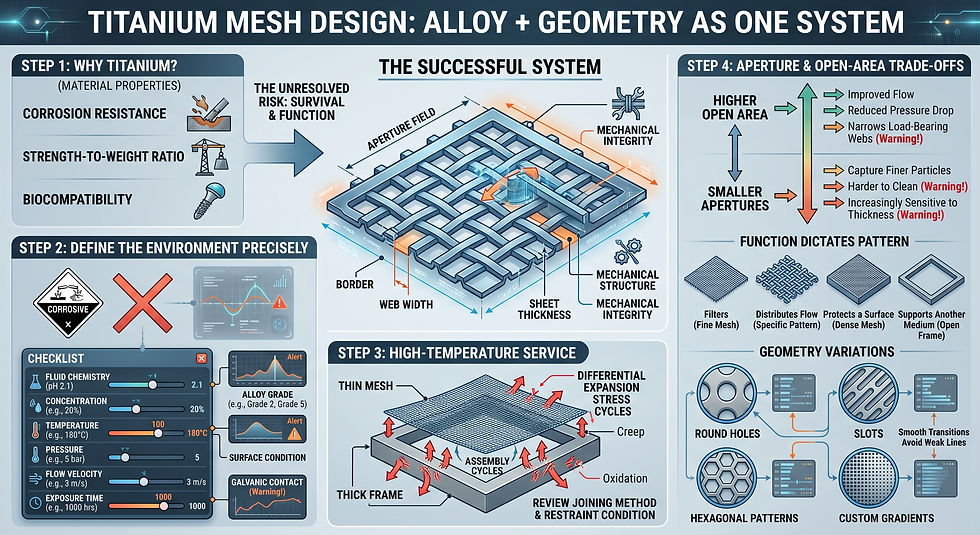
Titanium mesh design usually begins with the material's corrosion resistance, strength-to-weight ratio or biocompatibility. Those advantages explain why titanium is chosen, but they do not determine whether a particular screen will survive pressure, handling, cleaning or joining. The aperture field, border, web width and sheet thickness create the actual mechanical structure. A successful design treats the alloy and geometry as one system.
Define the environment precisely
Corrosive is not a complete material specification. Fluid chemistry, concentration, temperature, pressure, flow velocity and exposure time should be stated. Titanium performs extremely well in many environments, but alloy grade and surface condition still matter. Galvanic contact with other metals must also be considered.
For high-temperature service, creep, oxidation and differential expansion may control the design. A thin mesh attached to a thicker frame can experience stress as the assembly cycles. The joining method and restraint condition should be reviewed with the operating range.
Aperture and open-area trade-offs
Higher open area improves flow and reduces pressure drop, but it narrows the load-bearing webs. Small apertures can capture finer particles yet become harder to clean and increasingly sensitive to thickness. The correct pattern depends on whether the mesh filters, distributes flow, protects a surface or supports another medium.
Round holes, slots, hexagonal patterns and custom gradients are all possible. Local changes in aperture density can reinforce mounting zones while preserving flow in the active region. Transitions should be smooth enough to avoid weak lines.
Thickness and structural behavior
Thickness influences stiffness, pressure resistance and the minimum practical feature. A very thin screen may require a carrier or frame during processing and assembly. A thicker plate can carry more load but limits narrow webs and small openings.
Finite-element or pressure testing should use realistic boundary conditions. A mesh clamped around its full perimeter behaves differently from one welded at a few points. Drawing tolerances should focus on the features that control fit and function.
Why Photo Etching Fits Complex Titanium Mesh Design
Photo etching creates the full aperture pattern without a cutting tool contacting the sheet. It can produce dense, burr-free two-dimensional geometry and supports rapid pattern changes through digital artwork. This is useful for prototypes and specialized lower-volume components.
Complexity such as mixed hole zones, locating tabs, identification marks and irregular borders can be integrated into one flat part. However, titanium etching requires process expertise, and achievable feature size depends strongly on grade, thickness and pattern density.
Joining and secondary processing
Titanium screens may be welded, diffusion bonded, clamped or mechanically retained. Joining heat can distort thin material, while contamination can compromise weld quality. The component should be supplied in a condition compatible with the selected joining method.
Surface cleaning, pickling, passivation or coating requirements should be defined without assuming that every treatment suits every application. If the mesh will be formed, bend radius and springback need validation.
When another mesh technology is better
Expanded metal is efficient where three-dimensional stiffness and larger openings are acceptable. Woven titanium mesh provides standard mesh counts and high open area. Laser cutting may suit thicker parts with larger features. Photo etching is strongest when the component needs precise custom apertures, flatness and integrated geometry without hard tooling.
Information for quotation
Provide titanium grade, thickness, aperture pattern, open area, active region, border, operating media, temperature, pressure, joining method, flatness, quantity and cleaning specification. Flag any patient-contact, aerospace or critical-process documentation requirements.
Prototype under representative load
A flat titanium coupon cannot predict how a finished mesh will behave under differential pressure, thermal cycling or vibration. Prototype fixtures should reproduce the real clamping width, unsupported span and joint condition. Measure permanent deformation, crack initiation and changes in flow after cycling. If the screen supports another medium, test both layers together because contact points can concentrate stress.
Manufacturing trials should also confirm handling and cleaning. Titanium mesh may survive the operating environment yet be damaged during loading into a weld fixture or removed from a cleaning basket. Carrier geometry and packaging can be adjusted before volume production without changing the functional aperture field.
Frequently Asked Questions
Can Grade 2 titanium be photo etched?
Yes, Grade 2 is a common candidate, but feature capability depends on thickness, pattern and tolerance. Other grades require their own process review.
Is photo-etched titanium mesh burr-free?
The process avoids mechanical punching burrs because the material is removed chemically. The etched edge profile remains thickness-dependent.
Can titanium mesh be formed after etching?
Often yes. Forming must account for grade, temper, thickness, bend radius and the reduced stiffness created by the aperture field.
Key Takeaways
Titanium mesh design is a structural and environmental problem, not simply a material choice. Aperture, web width, thickness, support and joining determine whether the material's advantages survive in the final assembly.


Comments