Nickel Screens and Grids: Choosing Geometry for Harsh Environments

Updated: Sep 11

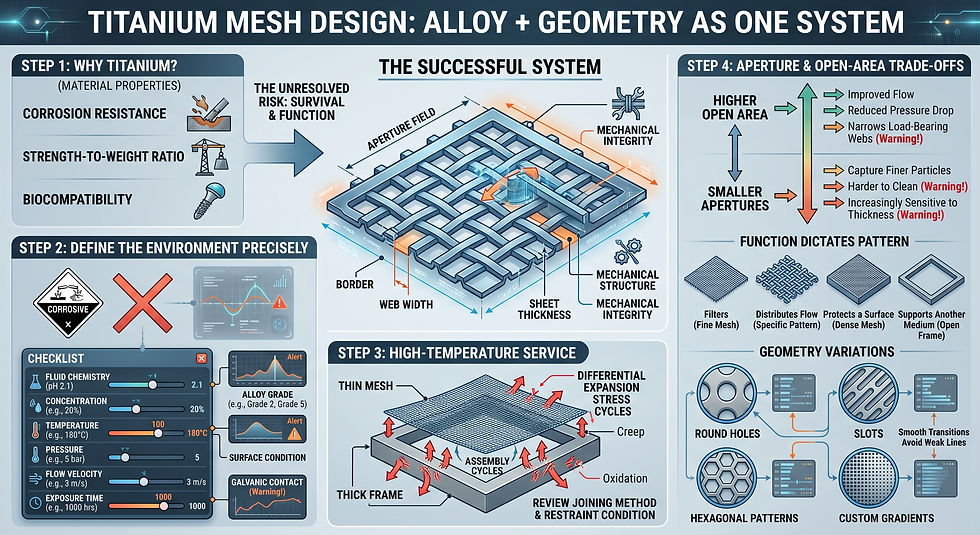
Nickel screens and grids are used where stainless steel or copper cannot provide the required combination of corrosion resistance, temperature capability, electrical behavior or dimensional stability. The material decision is important, but it is only the first step. A screen with the wrong aperture-to-thickness relationship can be difficult to manufacture, weak during handling or inefficient in service regardless of alloy quality.
Choose the nickel alloy from the environment
Pure nickel, nickel-copper alloys and high-temperature nickel alloys have different corrosion, strength and fabrication characteristics. The fluid, gas, temperature, electrical requirement and cleaning method should guide the grade selection. Using a premium alloy without defining the environment can add cost while leaving the real failure mechanism unresolved.
Material certification and traceability may be critical for aerospace, energy, laboratory and process equipment. State the exact grade, condition and thickness instead of relying on a broad nickel callout.
Aperture geometry controls function
Screens may filter particles, shape an electric field, support a membrane, distribute gas or protect a sensor. Each function creates a different balance between aperture size, pitch, open area and mechanical strength. The active field should be separated from the mounting border on the drawing.
Round holes offer predictable web geometry. Slots can direct flow or raise open area in one direction. Grids and custom patterns can align with electrodes or sensors. Pattern transitions should avoid long weak lines that encourage bending.
Thickness and minimum web width
Small apertures are not independent from thickness. As the sheet becomes thicker, lateral etching and wall profile consume more of the intended opening. Narrow webs also become difficult to reproduce consistently when surrounded by dense open area.
For handling, a slightly thicker sheet or reinforced border may be more valuable than a marginal increase in open area. If the part will be clamped, welded or bonded, reserve sufficient solid material for the joint.
Photo Etching Advantages for Nickel Screens and Grids
Photo etching produces complex flat patterns without tool wear or concentrated heat. It is suited to dense grids, mixed aperture zones and designs that may change during development. Multiple variants can be placed in the same photographic tooling layout.
Because there is no punching action, the part avoids conventional mechanical burrs and distortion from repeated shearing. Identification marks and partial-depth features may also be integrated after a design review.
Surface finish and cleanliness
Nickel components may require cleaning, plating or heat treatment depending on service. Residues trapped in fine apertures can compromise filtration, electrical performance or bonding. Cleanliness criteria should be measurable and tied to the application.
If the screen is welded or brazed, surface condition must suit the joining method. High-temperature exposure can change strength or flatness, so secondary processes should be considered in the tolerance plan.
When standard mesh is preferable
Woven nickel mesh is widely available in standard mesh counts and can provide high open area. Expanded metal can add stiffness. Laser cutting or machining may suit thicker structures. Photo etching is most attractive when the screen needs a custom outline, precise aperture placement, integrated tabs or rapid pattern changes.
RFQ checklist
Provide alloy grade, thickness, aperture dimensions, pitch, open area, active zone, mounting method, environment, temperature, surface treatment, cleanliness, quantity and inspection needs. Explain the screen's function so critical dimensions can be separated from general tolerances.
Plan inspection around the grid function
Inspection should follow the function of the grid. A filtration screen may require aperture distribution and damaged-web checks, while an electrode grid may depend more on positional accuracy, electrical continuity and alignment to a mating layer. Measuring every opening individually can add cost without improving confidence if a statistical or vision-based method better represents performance.
Agree how flatness is measured and whether the component is inspected in a carrier. Thin nickel parts can appear different when released from support, so the supplier and buyer should use the same restraint condition. Representative first-article samples can then establish the inspection method before routine production.
Frequently Asked Questions
Can nickel alloys be photo etched?
Many can, but etching response varies by composition and thickness. The exact alloy should be confirmed before tolerance and feature capability are promised.
Can a nickel grid include different aperture sizes?
Yes. Multiple zones and custom patterns can be integrated into photographic tooling, provided local web width and material support remain practical.
Is etched nickel better than woven mesh?
Neither is universally better. Etching offers precise custom geometry and integrated outlines; woven mesh offers standard formats and often very high open area.
Key Takeaways
Nickel screens and grids perform best when alloy selection and aperture design are based on the actual environment. Photo etching adds pattern flexibility, but thickness, web width, joining and cleanliness still set the practical limits.


Comments