Medical Device Metal Screens: Designing for Cleanability and Burr Control

Updated: Sep 11

Medical device metal screens often sit in places where a small geometric defect becomes a much larger functional problem. They may filter fluid, protect a sensor, support a membrane, separate particles or control flow inside diagnostic and surgical equipment. The screen must perform that function while remaining cleanable, traceable and compatible with the surrounding assembly. A drawing that specifies only hole diameter and outside profile leaves too many risks unresolved.
Define the screen's clinical or laboratory function
Begin by describing what must pass through the screen and what must be retained. Particle size, fluid viscosity, pressure drop and the consequences of partial blockage all influence aperture geometry and open area. A protective screen in an analyzer has different priorities from a component exposed to tissue or repeated sterilization.
The risk classification of the final device also affects documentation, validation and material controls. The component supplier needs to know whether the screen is disposable, reusable, implanted, fluid-contacting or isolated from the patient path. Manufacturing decisions should support the device maker's quality system.
Aperture size, pitch and open area
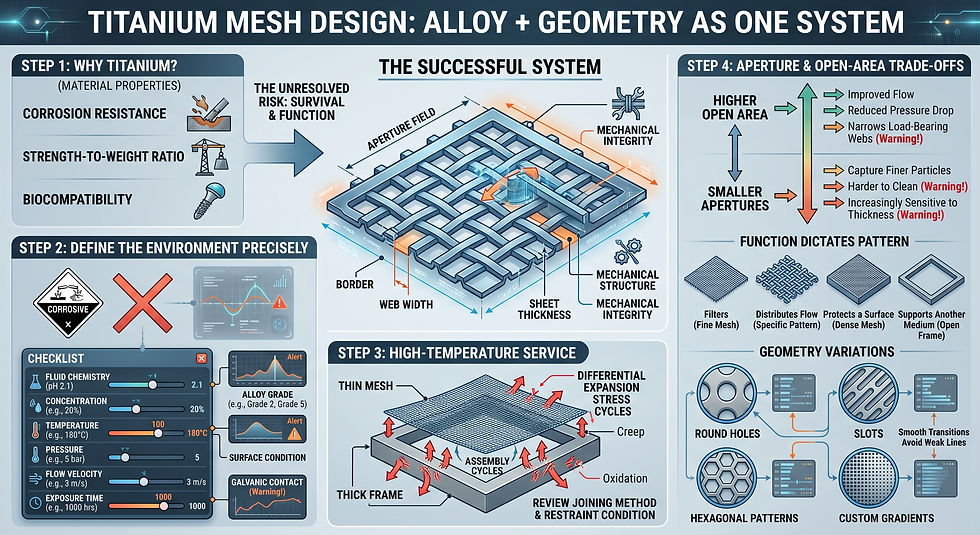
Apertures cannot be selected independently from sheet thickness and web width. Very small holes in relatively thick material develop a more pronounced etched profile and may be difficult to clean or inspect. High open area reduces pressure drop but leaves narrower webs that can deform during handling.
Round holes are common, but slots, tapered patterns and local zones can solve specific flow or support requirements. The drawing should identify the active filtration area, solid sealing border and any regions that must remain free of sharp transitions.
Cleanability begins with geometry
Residue can collect at abrupt steps, trapped corners or poorly defined interfaces. The screen should be reviewed together with gaskets, frames, welds and adhesives. A clean etched aperture does not guarantee a cleanable assembly if the perimeter creates an inaccessible crevice.
Surface finish and post-etch cleaning should be defined according to the application. Passivation, electropolishing or additional cleaning may be considered for stainless steel, but each step needs an agreed acceptance standard and traceable process route.
Burr control and edge condition
Photo etching removes material chemically, so it avoids the raised shearing burr associated with punching. That is valuable around dense apertures and delicate edges. The process still produces a thickness-dependent edge profile, and extremely small features should be reviewed using realistic cross-section expectations.
Handling tabs and panelization can keep thin screens protected through cleaning and inspection. Their break-off points must be placed away from sealing surfaces, fluid paths and patient-contact edges.
Material and sterilization compatibility
Stainless steel grades are common for corrosion resistance and established medical use, while titanium, nickel alloys and other materials may suit specialized environments. Material selection must account for the actual cleaning agents, sterilization cycle, temperature and contact media.
A generic callout such as stainless steel is rarely enough. Grade, temper, thickness, certification and surface condition should be stated. If biocompatibility is required, responsibility for finished-device validation must be clear.
When Photo Etching Fits Medical Device Metal Screens
Photo etching is strong for thin, complex screens where burr-free apertures, rapid design changes and mixed patterns matter. Stamping may be preferable for mature high volumes with suitable hole-to-thickness ratios. Woven mesh can provide very high open area, while laser cutting or machining may suit thicker structures. The process should be chosen around function and validation burden.
RFQ and validation information
Provide the drawing, material specification, thickness, aperture and open-area target, fluid or particle function, cleaning requirements, surface finish, inspection method, packaging, quantity and applicable quality documentation. Identify critical features rather than applying the tightest tolerance to the whole part.
Inspection should match the medical risk
Inspection effort should be proportional to the screen's function and failure consequence. Automated optical measurement can verify aperture size, pitch and damaged webs, while magnified visual inspection can check edge contamination and handling damage. For some devices, cleanliness testing or residue limits may be more important than tightening every profile dimension. The device manufacturer should define acceptance criteria that can be reproduced by both parties.
Change control is equally important. A material source, cleaning chemistry, packaging method or etching adjustment may require review even when the drawing revision has not changed. Recording these process links early reduces the chance that a successful prototype becomes difficult to validate in regular production.
Frequently Asked Questions
Are photo-etched medical screens burr-free?
They avoid mechanical punching burrs because the metal is dissolved rather than sheared. Edge profile and cleanliness still require inspection appropriate to the device application.
Can stainless steel medical screens be electropolished?
Often yes, depending on grade, geometry and finish requirements. Electropolishing changes edge and surface dimensions slightly, so it should be included in the tolerance plan.
Can one screen contain different aperture zones?
Yes. Photographic tooling can place several aperture sizes or patterns on one component, subject to thickness, web-width and process constraints.
Key Takeaways
Medical device metal screens should be designed as part of the fluid, cleaning and assembly system. Aperture geometry, material traceability, edge condition and validation requirements are inseparable.


Comments